

Data and Communications Are Not as Secure Without an Enhanced Retransmission Device (ERD): For Government Agencies, Corporations, or Individuals
Author(s): Jason Sebranek, Tara Clapper, Carl Nerup
Adversaries have a lot to gain from hacking into your mobile devices, especially if you handle intellectual property, sensitive material, or secure documents with mandatory federal government labeling. However, using mobile devices, given today’s remote work and frequent travel, is a necessity of the modern workforce.
The following are some examples of vulnerabilities in commercial 5G devices (which are fast and always connected), creating "leaks" in a high-security posture:
- Expanded attack surface: 5G moves away from centralized hardware to virtualized, software-defined components. This creates more software entry points and APIs that can be exploited compared to 4G.
- Downgrade attacks: Attackers can use rogue base stations ("stingrays") to force a 5G phone to drop to a 2G or 4G connection. These older protocols often lack the mutual authentication found in 5G, making it easier to intercept calls or data.
- Privacy leaks (metadata): Even if your data is encrypted, a commercial phone still broadcasts identifiers (like IMSI/SUCI[TC1] ) to the tower. This allows third parties to track the physical location of the device.
- Persistent connections: Commercial phones maintain numerous background connections to manufacturer servers, analytics trackers, and app stores. In a secure environment, these "silent" connections are unmonitored backdoors.
The reality: if you are working from a laptop using 5G or unsecured WiFi without additional security layers, you’re exposed. Competitors, adversaries, automated systems, and even the general public could gain access to your otherwise secure files, images, connections, and communications.
Without an advanced solution, this data is ripe for data thieves and their bad intentions. Through nefarious methods and the use of AI, they could access login information, satellite data, sensitive imagery, and information exposing OPSEC. This is a danger for individuals, but particularly for government agencies and corporations, where national security becomes vulnerable.
Enhanced Retransmission Devices (ERD) Can Increase Your Security Posture
A connected device, albeit a laptop, cellular device, or a tablet, is vulnerable to the risks above. This is how do we address these risks:
An Enhanced Retransmission Device acts as a high-security physical and logical buffer between your commercial phone and the rest of the world. It doesn't just "detect" threats; it physically re-engineers how the connected device talks to the network.
- Protocol break and firewall: The ERD forces a protocol break. Instead of the phone connecting directly to the 5G network, it connects to the ERD (often via a secure USB mux). The ERD terminates all traffic, inspects it at a deep level, and then re-transmits it. This ensures that no hidden malicious packets from the network can reach the phone’s OS directly.
- Admin vs. data: It ensures that the "Administrative" functions of the device (like updates) can never be touched by the "Data" functions (your web traffic), even if the device is under heavy attack.
- Forced VPN and obfuscation: The ERD acts as an "Enforcer." It can be configured so that the commercial phone cannot send a single byte of data unless it is inside a secure VPN tunnel. If the VPN drops, the ERD physically cuts the connection, preventing "leaks" that would normally happen on a commercial phone.
- USB muxing: Commercial phones are vulnerable to "juice jacking" or data theft via the charging port. An ERD typically includes a USB Mux that physically separates power pins from data pins, allowing you to charge in untrusted areas without the risk of data exfiltration.
Introducing the Aegis R52L
What if the solution was as simple as a small device you could attach to your laptop?
The good news: It is.
The Aegis R52L significantly minimizes the possibility of remote hacking. You’re a tougher target—which makes data thieves more likely to move on to someone else.
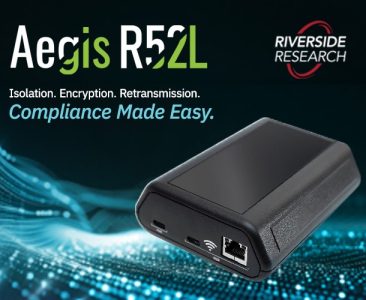
The Aegis R52L is a compact ERD purposely built to the NSA’s Commercial Solutions for Classified (CSfC) laptop use case. Designed and manufactured in the US, the Aegis R52L supports key laptop connection methods (Ethernet, WiFi and USB-C) and meets NSA CSfC’s Mobile Access Capability Package (MACP) requirements for ERDs.
The Aegis model features:
- Two independent processor approach—creating true hardware separation between the Wide Area Network (WAN) and the Local Area Network (LAN)
- Ability to connect to a Wide Area Network via Ethernet, Wi-Fi, or USB-C
- Can connect to an EUD via Ethernet, Wi-Fi, or USB-C
- Support for a dedicated outer VPN running on the ERD rather than on the EUD—freeing up customer resources and providing added flexibility to device administrators in terms of device setup
When possible, you should never connect to a network you don’t control, but upgrading the connection with an ERD can keep you safe and connected. Without the Aegis R52L, it’s like you’re connecting directly to an adversary, exposing your communications, data, and login information to them.
Avoiding this misstep is simple.
Contact Riverside Research about Aegis R52L today and match CSfC requirements or visit us at CSfC to learn more.
Inquire about Riverside Research's Aegis R52L ERD Solution
Enhance security for your organization. Please provide your contact information to inquire about the Aegis R52L ERD.
Featured Riverside Research Author(s)
Jason Sebranek
Jason Sebranek is the Director of the Resilient Production Solutions group at Riverside Research. His team designs and builds secure edge encryption devices, aligned with NSA’s CSfC and High Assurance standards. Prior to Riverside Research, Jason served as the Chief Technology Officer of Cog Systems, with responsibilities including product and technology planning/roadmap, cybersecurity architecture, and industry partnership development. He began his career in 2002 with Northrop Grumman, advancing through secure mobility related roles as a Lead Software Engineer, IRAD Principal Investigator, and Technical Fellow. Jason holds a Bachelor of Science Degree in Computer Engineering from the University of Virginia.
LinkedIN
Tara Clapper
Tara Clapper is a marketing strategist and content creator at Riverside Research. Her professional background includes technical writing, social media management, publishing, marketing, editorial duties, analog game design, prompt engineering, and content management in govcon, academic, and private sector spaces. Tara helps tell the Riverside Research story by interviewing SMEs for blogs, press releases, and social media channels. Tara holds a Bachelor of the Arts in English from McDaniel College.
LinkedIN
Carl Nerup
Carl Nerup is the VP of Corporate Development at Riverside Research, including strategic initiatives, partnerships, and alliances. A communications industry veteran, he brings a wealth of knowledge to the leadership team with demonstrated successes in cyber security, embedded systems, mobile/wireless, and new product development.
Prior to Riverside Research’s acquisition of Cog Systems, Carl served as its founder and CEO. He previously worked as the Global Vice President for Samsung where he had responsibility for the secure mobility business. His background also includes strategic development support at General Dynamics and Vice President, Strategic Business Development and Venture & Equity Portfolio Management, at AT&T.
Carl attended the United States Naval Academy and holds a Bachelor of Science from Seattle University. He also received a degree in Data Communication from the University of Washington.
LinkedIN
The above listed authors are current or former employees of Riverside Research. Authors affiliated with other institutions are listed on the full paper. It is the responsibility of the author to list material disclosures in each paper, where applicable – they are not listed here. This academic papers directory is published in accordance with federal guidance to make public and available academic research funded by the federal government.